Jim of Seattle wrote:Jast, that was really interesting about your training. I've never been trained but can carry a tune and have only been called out for a troublesome vocal quality a couple times, but my wife has the coolest voice I've ever heard, and is completely untrained. she coukd definitely benefit from lessons, but I'm not sure that what I dig about it isn't that very untrained quality.
There is no such thing as an "untrained quality".

Training is for creating habits that let you use your voice the way it works best. Some people pick up those habits naturally as they go along... those are often (but not always) people who have voices that aren't particularly hard to master in the first place; voices with a lighter quality. Lighter voices are much more difficult to mess up. Now obviously I don't know your wife's voice, so I couldn't say whether she sounds great because she has an "easy" voice and can use it well naturally, or because somehow she lucked out and can naturally use a different kind of voice well.
What I'm talking about here isn't classical training, by the way. It just goes in roughly the same direction, but not nearly as far. It takes bad stuff out of the vocalizing without going so far as trying to achieve absolute perfection (= most efficient use of voice in terms of effort vs. perceived power). And I'm not talking about learning to keep pitches, either, because I've never really had serious difficulties with that... although the completely different vocal technique requires different ways to control intonation, and so sometimes my pitch is actually worse than before. I'm working on it.

sportswriters wrote:If you don't know how to belt you've only discovered half your voice, by the way
I think the idea of "belting" is based on a misleading perspective on singing.
Let's start out with a brief explanation of how the voice works. The vocal folds are two protrusions somewhere in the larynx, and sound is produced when they are approximated (closed against each other) and air flows through them to push them apart. Given an appropriate combination of air pressure and approximation, they will rapidly push apart and then get back together again, and repeat that many times per second... this oscillation creates a pitched sound.
First topic: registers. There is one very clear distinction that is easy to make, functionally: full voice vs. falsetto. Falsetto creates a weak/soft tone that comes from pushing more air through the vocal folds than normal, and only a small part of the vocal folds is actually participating in the oscillation. Here's an illustration:
http://upload.wikimedia.org/wikipedia/c ... imated.gif
The other main functional register is the modal voice. This is, essentially, the normal speaking voice (if you speak properly, anyway), and what you'd call chest voice: it has a full sound with plenty of overtones. The difference is that a much larger part of the vocal folds "meets". Here's an illustration:
http://upload.wikimedia.org/wikipedia/c ... imated.gif — compare that to the previous example. Quite a difference, isn't it? And even though it doesn't look like it would do
that much, that difference is the difference between a soft, breathy voice and a strong, rich voice.
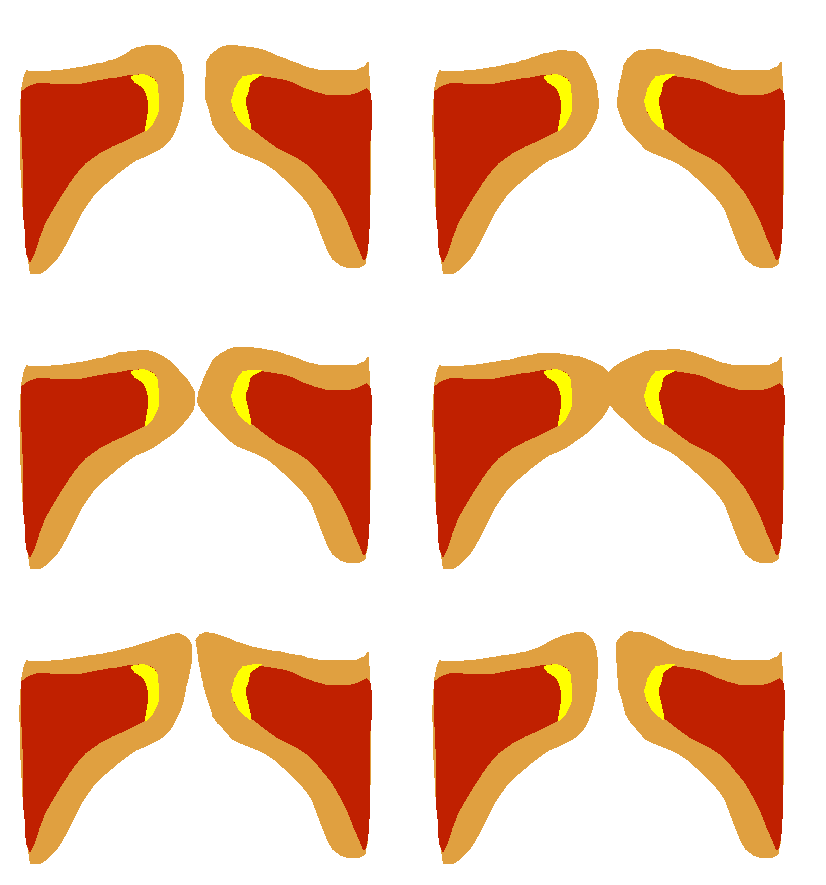
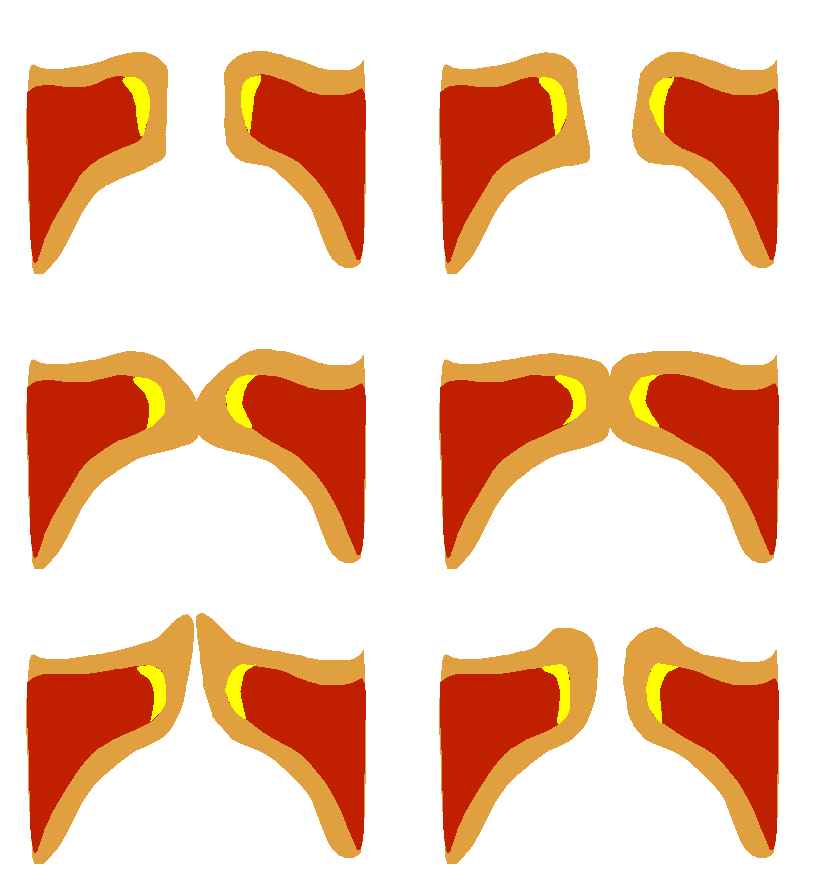
How are they produced differently? Well, the only muscles the vocal folds have themselves are those they use to tense up, used (among others) to regulate pitch. These are used for the modal voice, but not for the falsetto voice. In that, other muscles are used to pull the vocal folds taught (so they aren't really capable of doing the modal kind of oscillation anymore). In addition, only part of the vocal folds actually meets. In contrast to the previous pictures that showed a side view/cross-section of the vocal folds, look at this illustration that shows a view from the top:
http://upload.wikimedia.org/wikipedia/c ... itions.png — the sail shapes are the vocal folds, and the inner edges are those that you saw meet up in the other view. As you can see, they can be made to have a different distance to each other, and falsetto means that they are positioned like something between C and D (where C is modal voice)... so some parts of the folds close together and the rest is open (except in folks who are extremely good at falsetto). This, of course, means that the sound is weaker.
In general, falsetto is much easier to do, because for the modal voice, as pitch increases, the way the vocal folds are controlled gradually shifts to involve more/different muscles. More importantly, breath must be controlled much better... because if there isn't enough air flow, the oscillation doesn't work (because the air pressure isn't strong enough to push the vocal folds apart), and if there is
too much air flow, the pressure is so strong that the vocal folds break apart; this is what people usually call a "break". The solution is called breath support and involves controlling breath pressure with a bunch of muscles situated below the diaphragm. Roughly, those muscles are used to pull the diaphragm down (this expands the lungs and thus pulls breath into them), keep it down (this makes sure the breath isn't expelled in an uncontrolled fashion) and release it at just the right speed (which depends on the pitch you're singing) so that the vocal folds can do the modal voice correctly. There will also be a partial vacuum in the lungs that contributes to pulling the vocal folds back down each time after they have been pushed apart.
Now I've explained enough stuff to get back to the initial topic.
If you do this stuff very well, you naturally get a powerful and natural sounding voice even towards the upper end of your range. If you don't, chances are that your vocal folds will do an oscillation style that's somewhere between falsetto and modal (though your vocal folds will be approximated on the complete length, i.e. position C)... that one is easier to maintain, but if you don't do proper breath control, the pressure has to be controlled elsewhere. This elsewhere will end up being your throat (mostly the root of your tongue, which is somewhere in your throat where you can't see it). And, guess what, the body isn't designed to control pressure in your throat, at least not during singing. The result is pain — and the "strained" sound we all know.
Some vocal teaching claims that the fix is to use a so-called "head voice". There is no such thing, functionally speaking. To the extent that people aren't simply referring to proper technique (as described above) when they speak of "head voice" (and in that case there is simply a natural-sounding gradual change of the sound of your voice across your vocal range), it usually means that you are supposed to do some tricks with your muscles that remove the strain at the cost of making the voice sound weaker/softer.
Now, there are different definitions of belting, and some of them presuppose that there is such a thing as head voice, so the whole issue is rather confusing. By my definitions, belting is simply proper technique at higher pitches. There are ways to make it sound somewhat more "aggressive", too... by default it just sounds "powerful" and "damn good".
Disclaimer: die-hard fans of "speech-level singing" and the like are going to disagree wildly. Well, whatever. SLS didn't work out all that well for me, but this stuff here is delivering. YMMV, but I kind of doubt it.