Page 2 of 3
Posted: Fri Mar 14, 2008 6:59 pm
by Caravan Ray
Kill Me Sarah wrote:My wife really wants me to get her something cute. Ideas?
I'm free this weekend
Posted: Fri Mar 14, 2008 7:01 pm
by Kill Me Sarah
Caravan Ray wrote:Kill Me Sarah wrote:My wife really wants me to get her something cute. Ideas?
I'm free this weekend
Promises, promises. You're like a 12 hour flight away, you'd never make it in time.
Posted: Fri Mar 14, 2008 7:24 pm
by Kill Me Sarah
Further on the subject of setting up a guitar... is it just me or is this action pretty high?
How can I get it lower? it's good up towards the nut but seems to rise rather drastically.

Posted: Fri Mar 14, 2008 8:21 pm
by king_arthur
Yeah, that does look pretty high... it also looks like the neck is actually a bit concave, but that could just be the photo... but if the neck looks concave in reality, you could try tweaking the truss rod to straighten the neck. On an acoustic, the process for lowering the bridge is a bit different than an electric, you pull out the ivory-ish bridge and file it down... carefully. Did somebody post-install a piezo bridge pickup? That might have caused the bridge to be high...
Charles (KA)
Posted: Fri Mar 14, 2008 8:32 pm
by bz£
Kill Me Sarah wrote:ken wrote:Are amps something else you'd like to tinker with? If so, check out the Epiphone Valve Jr. I've got he head and a kit to upgrade it. I also like the look of the Crate Blackheart series. (Yes, I am a fan of low-watt tube heads.)
I'll tinker w/ anything if it's not too complicated. If it gets too complex, I generally like to watch someone else do it first. But I have cracked open my iPod

For what it's worth, DO NOT go tinkering with your amp unless you are sure you know what you are doing, and you are careful and more sober than me on a typical day. An amplifier can be unplugged for a week and still carry enough charge in the capacitors to KILL YOU. No kidding.
Posted: Fri Mar 14, 2008 9:04 pm
by Spud
Word, Ben. I have found that you can find instructions online for discharging the capacitors on many amps. I have an old Kalamazoo that I try to fix every so often, and there are even docs on that. Well worth it, in my opinon.
Posted: Fri Mar 14, 2008 9:05 pm
by Ross
This ROndo Music thing looks kinda interesting. For some time I've been thinking I needed to get a decent double humbucker guitar on the inexpensive end (I play a standard tele). Would I be better off with one of these or an epiphone SG special? Thoughts?
Posted: Fri Mar 14, 2008 9:15 pm
by Märk
That action is unplayably high. Unless you play slide exclusively.
How to set up your guitar so it plays nice.
Bridge:
1a) Make sure the guitar is perfectly in tune, using the gauge of strings you prefer (then stick with that gauge forever). Use a tuner to make sure you're not slack or high tuned.
1b) Get a capo. If you don't have a capo, improvise something that will fret all strings snugly at a given fret. You need both hands to do other stuff.
2) Capo your guitar at the 14th fret.
3) Pluck each string in turn to make sure none of them are buzzing against the higher frets. You want clear, bell-like notes. If any are buzzing, start adjusting the bridge upward (either on the individual saddle, a la a Fender bridge, or the bridge posts, a la Gibson style with fixed saddles) Check the offending sting continuously, and adjust up until it rings clearly.
4) If none of the strings buzz, start adjusting the bridge (saddles or posts) down until they *just* start to buzz, then go a half turn back. Okay. Bridge height is done.
Neck:
1) Put the capo on the 1st fret. Starting with the low E, depress the string at the 14th fret. Hold the guitar at eye level, looking at it from the side of the neck, and see how much space there is between the string and the 6th fret. If it a lot (say, enough to slide a guitar pick between it easily) you neck is bowed out too much. If it is actually touching the fret, your neck is bowed in. There should be a space about the thickness of a piece of cardstock there. Not what you're seeing? Okay, then we...
2) ...adjust the truss rod. If you're scared to do this, don't be. Just don't do anything stupid. The truss rod adjuster is usually found under the triangular piece of plastic directly behind the nut. Sometimes it's inside the soundhole, on the opposite end of the neck on acoustic guitars. Use the proper tool, either an allen key or small socket, and give a *minute* little tweak in either direction, if it turns smoothly, great. If the nut (or bolt-end, on some necks) doesn't turn easily, spray a quick blast of WD-40 or similar in the cavity and leave it a few minutes. Repeat if neccessary. What you want to do is loosen (lefty/loosie, righty/tighty) the bolt if the neck is bowed in, and tighten it if it's bowed out too much. Turn the bolt 1/4 turn at a time, and recheck the string/fret distance as above. Be sure to tune the strings after each tighten/loosen cycle. All of them. The exact tension of all strings, in tune, is what we want.
3) If you are tightening (pulling the neck straight against the string tension) and find the bolt is getting difficult to turn, DON'T FORCE IT. It *is* possible to snap/strip the nut off, basically ruining the truss rod and probably the neck. Oil liberally, and try again. If it just won't budge, you may be S.O.L. If you are able to get the neck to the point where both the high and low E strings have perfect clearance at the 6th fret, congrats! If one is perfect and the other is out of whack, you have a twisted neck. The guitar may still play perfectly fine, but adjusting the truss rod will not help a whole lot, because either the low strings will be perfect and the high strings too high or low, or vice versa. Anyway, let's move on to...
Intonation:
1) This seems to intimidate a lot of people. I don't know why, it's so simple to set the intonation that even a retarded baby could do it. Okay, i exaggerate. Using an electronic tuner (or the tuner built into Guitar Rig, or I believe Sonar has one too) Starting with the low E, play, in this order: a) Open string. It should be dead on in tune. If not, tune your damned guitar! b) 12th fret harmonic. Should be dead on in tune again. It is, after all, just a fundamental of the open string, right? Now, here's where the magic comes in: c) fretted 12th fret note. Use a very light touch. Is it dead on, or almost dead on in tune? Great, you don't need to adjust that string. If it's:
2) Too high. The string needs to be lengthened. The distance between the 12th fret and bridge saddle should be identical to the distance between the nut and 12th fret. In other words, the 12th fret should be *exactly* dead center between the nut and bridge saddle. So, to lengthen the string, adjust the string's saddle back, by tightening the adjustment screw. This will tighten the string slightly too, so retune and try again. Keep doing this until the fretted 12th note and 12th fret harmonic are identical or almost identical. (some guitars can not be perfectly adjusted. quite a few, actually)
3) Too low. The same as above, but shorten the string. (yes, by loosening the adjustment screw.)
4) Do this with all strings. Now play barre chords up and down the neck and marvel at how nice they sound suddenly!
Man, I should publish this.
Posted: Sat Mar 15, 2008 12:18 am
by Kill Me Sarah
You should publish it. Question: it sounds from your instructions that you're describing adjusting the bridge of an electric guitar (which will be most useful when mine comes). How does one go about adjusting the bridge on an acoustic (which is pictured)? Is that where the filing comes in? Cuz I think my bridge piece is plastic... can you file that?
Posted: Sat Mar 15, 2008 12:39 am
by Billy's Little Trip
That looks pretty good Mark.
Posted: Sat Mar 15, 2008 6:54 am
by Paco Del Stinko
Mark - Nice, easy to understand instructions. Funny, though, I'm scared of truss rods but not intonation.
Ross - Try out the guitars. Both should have fast-ish action and sound big, the SG a lot lighter to strap on.
KMS - You can try filing the bridge or even sanding, but you first want to make sure you don't break anything in removing it. And be careful with the amps, those guys aren't kidding about stored electrical charges. Also:
KMS wrote:Anyone else surprised that Jack White, Joe Perry, and a couple others there don't set up their own guitars?
Not surprised a bit. And if all of this is too much, any music shop should have a basic set-up available for 30-40 bucks. But probably better to learn yourself. This is the book that I just picked up, and it looks like most you'd ever need to know, but I haven't applied any it yet.
http://www.amazon.com/Guitar-Player-Rep ... im_b_1_img
Posted: Sat Mar 15, 2008 8:23 am
by Märk
Kill Me Sarah wrote:Question: it sounds from your instructions that you're describing adjusting the bridge of an electric guitar (which will be most useful when mine comes). How does one go about adjusting the bridge on an acoustic (which is pictured)? Is that where the filing comes in? Cuz I think my bridge piece is plastic... can you file that?
Yeah, I guess that was geared toward electric guitars. You can take the strings off, the plastic or bone saddle should just slide out of the wooden slot. You have to be careful, if it's an acoustic/electric, there will be a piezo strip under it, don't damage that removing/replacing the saddle. Use a medium or course file and clamp the saddle to a workbench, also, use a caliper to make sure you're not taking too much material off the bottom (flat) part of the strip. If you need to add material to it, you'd be better off buying a blank from a music store and starting from scratch. If you are adventurous, though, you can add a shim to it- unless you use bone or hard plastic shims, you will kill the tone though.
Acoustics are much harder to adjust bridges on, because you have to remove strings, fiddle with the saddle, then put the strings back on, test, and repeat. From the looks of your picture, your neck is bowed out, so I'd suggest a truss rod adjustment. The top of the guitar may have lifted too, in which case it's beyond the scope of my advice, and probably not worth fixing.
Posted: Sat Mar 15, 2008 2:44 pm
by Billy's Little Trip
Paco Del Stinko wrote:Mark - Nice, easy to understand instructions. Funny, though, I'm scared of truss rods but not intonation.
Heh, me too. I always fear that I'm going to permanently warp my neck or something, but it always comes out ok. When it came to re-fretting my old SG, I took it to my friends shop. He has a laser rig that gets the neck and frets to perfection. Money well spent.
Posted: Sat Mar 15, 2008 3:34 pm
by Märk
Billy's Little Trip wrote:When it came to re-fretting my old SG
SG 4TW. Nicest guitar ever conceived of. And to imagine Les Paul himself didn't like it, and refused to allow his name to be attached to it.
Posted: Sat Mar 15, 2008 4:13 pm
by Billy's Little Trip
SG 4TW, haha. I had to stop and think about that for a second. I thought you knew about some rare SG I never heard of.

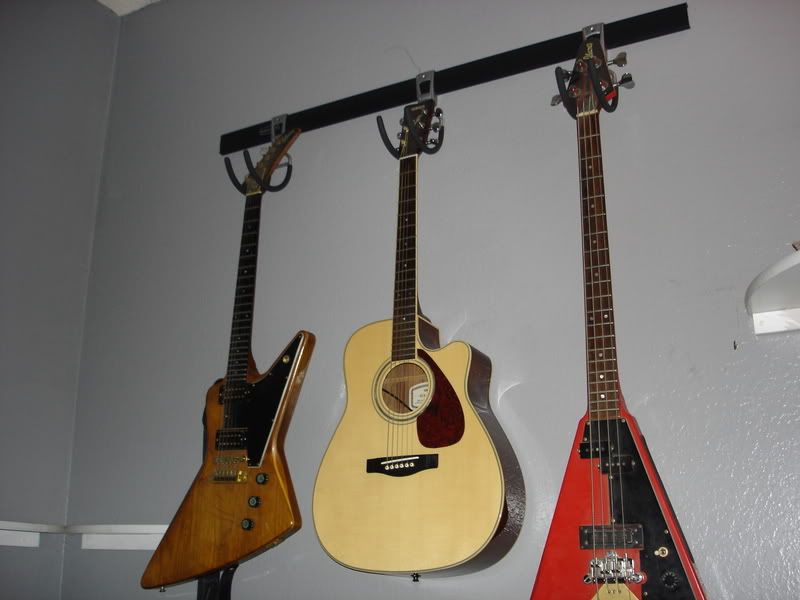
Yes, SG for the win, indeed. I like the rich tones of my Les Paul, but the SG with the soap bars really screamed, and much lighter. But I'd still take my Explorer with the dirty finger pick ups over both. I love that guitar. It's an ugly beast, but perfect for all occasions. I need to give it some TLC one of these days. All the gold plating is tarnished, the crevices are grungy, the cord jack is temperamental, etc. I've wanted to repaint it from the time I got it, but the older it gets, the more I don't want to alter it. It's a mahogany top and rosewood fret board.
Posted: Sat Mar 15, 2008 7:33 pm
by Märk
Billy's Little Trip wrote:SG 4TW, haha. I had to stop and think about that for a second. I thought you knew about some rare SG I never heard of.
Yes, SG for the win, indeed. I like the rich tones of my Les Paul, but the SG with the soap bars really screamed, and much lighter. But I'd still take my Explorer with the dirty finger pick ups over both. I love that guitar. It's an ugly beast, but perfect for all occasions. I need to give it some TLC one of these days. All the gold plating is tarnished, the crevices are grungy, the cord jack is temperamental, etc. I've wanted to repaint it from the time I got it, but the older it gets, the more I don't want to alter it. It's a mahogany top and rosewood fret board.
Pics!
Posted: Sat Mar 15, 2008 10:33 pm
by Billy's Little Trip
Märk wrote:Billy's Little Trip wrote:SG 4TW, haha. I had to stop and think about that for a second. I thought you knew about some rare SG I never heard of.
Yes, SG for the win, indeed. I like the rich tones of my Les Paul, but the SG with the soap bars really screamed, and much lighter. But I'd still take my Explorer with the dirty finger pick ups over both. I love that guitar. It's an ugly beast, but perfect for all occasions. I need to give it some TLC one of these days. All the gold plating is tarnished, the crevices are grungy, the cord jack is temperamental, etc. I've wanted to repaint it from the time I got it, but the older it gets, the more I don't want to alter it. It's a mahogany top and rosewood fret board.
Pics!
Well, here's what's hanging on the wall behind me. I use these 3 for all my recording. It's hard to see from this pic, but my Explorer has that not so fresh feeling. The gold used to sparkle.
Posted: Sun Mar 16, 2008 5:14 am
by Paco Del Stinko
Nah, don't spiff up the guitar, you'd be re-writing history. Keep it clean and fuctioning properly, absolutely, but fades/dings/scars are part of its history. Love the tone of that bass.
Posted: Sun Mar 16, 2008 9:02 am
by Ross
While I don't normally think this man is a source of wisdom, I think it was Billy Idol who said, "If you don't have any scratches on your guitar, you're not playing it properly."
Posted: Sun Mar 16, 2008 9:06 am
by Märk
Hey, that's a beauty. How old is it?
I agree with Paco, don't alter it. Get some brasso and take all the hardware off and polish it if you want it to sparkle. Or give it to me. I'll, uh, take good take of it, I promise.
Posted: Sun Mar 16, 2008 2:04 pm
by Billy's Little Trip
Honestly, I don't know exactly how old it is, but from things I've read, my exact guitar was only made from 1979 to 1983. The only Explorers that came out of the factory with the TP-6 tail piece were 79-83. So, 25 to 29 years old. How old is considered vintage?
Also, while checking facts just now, it appears I'm wrong about the body being mahogany. I knew that Explorers came in mahogany, and mine is a dark wood with a clear finish. BUT, from 79-83, they only came in walnut with a mahogany neck and only came from the factory in natural finishes. And sure as shit, I took a close look at the neck and body, and the mahogany and walnut wood grain is like night and day different. So I learned something today. #1. I don't know my woods. #2. My guitar is walnut with a mahogany neck.
Posted: Sun Mar 16, 2008 2:18 pm
by Ross
Hey chris - check out this page, you may be able to find out more about the date of the guitar.
http://www.theguitarfiles.com/guitarfile534.html