
I was recently reminded of an old guitar stringing trick for Les Paul type set-ups that I had never tried. String through the stop tail from the other side, then up and over to the bridge. Paco's Les Paul bridge photos Look at the difference in string angle from where they used to come out (where the string balls now go in) After a few days, I'd have to say that the guitar feels a bit more slinky, and sustain is improved. This is the only guitar that I string with .009s (!), and the higher strings could get a little flabby sounding at times. This may give a cheaper guitar a wee bit more oomph.
Perhaps this is not news to most, and if you are aware of drawbacks, please come forth with them. Looks like a good recipe for fewer string breakages, although that's not necessarily a problem.
Stringing up a Gibson type guitar.
-
Paco Del Stinko

- Roosevelt
- Posts: 3550
- Joined: Fri Apr 07, 2006 11:20 am
- Instruments: Basic rock, at a basic level.
- Recording Method: Roland 2480
- Submitting as: Paco del Stinko
- Location: Massachusetts. God save the Commonwealth!
Stringing up a Gibson type guitar.
Bringin' the stink since 2006.
-
Billy's Little Trip

- Odie
- Posts: 12090
- Joined: Mon Nov 13, 2006 2:56 pm
- Instruments: Guitar, Bass, Vocals, Drums, Skin Flute
- Recording Method: analog to digital via Presonus FireBox, Cubase and a porn machine
- Submitting as: Billy's Little Trip, Billy and the Psychotics
- Location: Cali fucking ornia
Well, there is no doubt in my mind that getting the tail piece tight to the body is going to increase sustain and offer a better tone, I figured that out years ago. And as you said, reducing the string angle is going to reduce string tension for a looser feel and sound.
My question. With reduced tension, what does that do when you start bending strings? Theoretically you have to bend the string more to hit the pitch of next step, right? Not a big deal, but a guy might have to retrain him/herself.
Also, just fretting a note, which is basically bending a note, how is that effected?
I suppose it wouldn't be to dramatic, considering a tremolo and other rear pieces are designed with less angle. My Gibson Explorer has the tune-o-matic tail, so it is tight to the body with very little string angle because the bridge is low for better action.
My question. With reduced tension, what does that do when you start bending strings? Theoretically you have to bend the string more to hit the pitch of next step, right? Not a big deal, but a guy might have to retrain him/herself.
Also, just fretting a note, which is basically bending a note, how is that effected?
I suppose it wouldn't be to dramatic, considering a tremolo and other rear pieces are designed with less angle. My Gibson Explorer has the tune-o-matic tail, so it is tight to the body with very little string angle because the bridge is low for better action.
-
roymond

- Ibárruri
- Posts: 5263
- Joined: Sat Sep 25, 2004 3:42 pm
- Instruments: Guitars, Bass, Vocals, Logic
- Recording Method: Logic X, MacBookPro, Focusrite Scarlett 2i2
- Submitting as: roymond, Dangerous Croutons, Intentionally Left Bank, Moody Vermin, The Reverend
- Pronouns: he/him
- Location: brooklyn
- Contact:
Not sure how that's affected at all. The bridge is still in the same place, so the same string weight is still stretched the same distance to produce a note, thus the tension is the same and bending is unaffected. As for the angle of the string being different coming from over the tail piece, yes, fewer broken strings at that place is on the menu.Billy's Little Trip wrote:My question. With reduced tension, what does that do when you start bending strings? Theoretically you have to bend the string more to hit the pitch of next step, right? Not a big deal, but a guy might have to retrain him/herself.
Also, just fretting a note, which is basically bending a note, how is that effected?
roymond.com | songfights | covers
"Any more chromaticism and you'll have to change your last name to Wagner!" - Frankie Big Face
"Any more chromaticism and you'll have to change your last name to Wagner!" - Frankie Big Face
-
Billy's Little Trip
- Odie
- Posts: 12090
- Joined: Mon Nov 13, 2006 2:56 pm
- Instruments: Guitar, Bass, Vocals, Drums, Skin Flute
- Recording Method: analog to digital via Presonus FireBox, Cubase and a porn machine
- Submitting as: Billy's Little Trip, Billy and the Psychotics
- Location: Cali fucking ornia
I'm not so sure about that. I've done things behind the bridge to change pitch, in the past.roymond wrote:Not sure how that's affected at all. The bridge is still in the same place, so the same string weight is still stretched the same distance to produce a note, thus the tension is the same and bending is unaffected. As for the angle of the string being different coming from over the tail piece, yes, fewer broken strings at that place is on the menu.Billy's Little Trip wrote:My question. With reduced tension, what does that do when you start bending strings? Theoretically you have to bend the string more to hit the pitch of next step, right? Not a big deal, but a guy might have to retrain him/herself.
Also, just fretting a note, which is basically bending a note, how is that effected?
Example. If you fret a string and pluck between the tail and bridge, then start bending the string, the pitch will change while plucking behind the bridge. That indicates to me that the change of tension does effect the pitch.

-
Billy's Little Trip
- Odie
- Posts: 12090
- Joined: Mon Nov 13, 2006 2:56 pm
- Instruments: Guitar, Bass, Vocals, Drums, Skin Flute
- Recording Method: analog to digital via Presonus FireBox, Cubase and a porn machine
- Submitting as: Billy's Little Trip, Billy and the Psychotics
- Location: Cali fucking ornia
-
roymond
- Ibárruri
- Posts: 5263
- Joined: Sat Sep 25, 2004 3:42 pm
- Instruments: Guitars, Bass, Vocals, Logic
- Recording Method: Logic X, MacBookPro, Focusrite Scarlett 2i2
- Submitting as: roymond, Dangerous Croutons, Intentionally Left Bank, Moody Vermin, The Reverend
- Pronouns: he/him
- Location: brooklyn
- Contact:
Sorry, I guess I missed the bending-the-string-behind-the-bridge part. I thought you meant bending the string on the fret board. Yes, having a longer section of string between bridge and the post or whatever that thing is called will make it easier, but because it's a longer section of string, not because the tension to which the string is tuned has changed. I thought you were implying that wrapping the string around the stock piece somehow changed the tension of the string.Billy's Little Trip wrote:I'm not so sure about that. I've done things behind the bridge to change pitch, in the past.roymond wrote:Not sure how that's affected at all. The bridge is still in the same place, so the same string weight is still stretched the same distance to produce a note, thus the tension is the same and bending is unaffected. As for the angle of the string being different coming from over the tail piece, yes, fewer broken strings at that place is on the menu.Billy's Little Trip wrote:My question. With reduced tension, what does that do when you start bending strings? Theoretically you have to bend the string more to hit the pitch of next step, right? Not a big deal, but a guy might have to retrain him/herself.
Also, just fretting a note, which is basically bending a note, how is that effected?
Example. If you fret a string and pluck between the tail and bridge, then start bending the string, the pitch will change while plucking behind the bridge. That indicates to me that the change of tension does effect the pitch.
roymond.com | songfights | covers
"Any more chromaticism and you'll have to change your last name to Wagner!" - Frankie Big Face
"Any more chromaticism and you'll have to change your last name to Wagner!" - Frankie Big Face

-
Märk

- Churchill
- Posts: 2051
- Joined: Sat Sep 25, 2004 8:35 pm
- Instruments: Guitar, bass
- Recording Method: Cubase, Steinberg CI2
- Submitting as: ROTR, svenmullet, I forget what else
- Pronouns: it
- Location: Canada
Only caveat here is that it will cause most of the tension on the tailpiece to be at the very top, twisting it forward. With years of aggressive playing you might flange out the post holes (yeah, I know mahogany is pretty tough, but brass is tougher) and this is a major repair.
Other than that, if it feels good, do it!
Other than that, if it feels good, do it!
* this is not a disclaimer
-
Sober

- Niemöller
- Posts: 1731
- Joined: Sat Sep 25, 2004 10:40 am
- Instruments: Pedal steel, mandolin, etc etc
- Recording Method: Pro Tools
- Submitting as: Sober, I'm Steel Learning
- Pronouns: he/him
- Location: Midcoast Maine
I didn't read much of this thread, but I saw the photos and here's a few points:
The only thing (outside of materials used) that affects sustain is increasing the angle behind the bridge and nut. This is why many people consider the gibson 17% angled neck superior to the fender flat neck. This is also the reason you scallop the fingerboard of a guitar (other than that it feels cool). Stringing behind the bridge reduces the sustain, because the angle becomes flatter. This is plainly seen in Paco's pictures.
The only way to alter string tension (at same pitch) is to change the distance between the nut and bridge, or to change string gauge. So, either you switch to a longer scale guitar, or you get lighter strings. That's it. The angle behind the nut doesn't matter, the distance behind the nut/bridge to the anchor doesn't matter either.
There is a percieved change in tension when your anchor is moved further from the bridge (as seen in Paco's pics). This manifests particularly when you bend the strings.
Again, if the distance between the bridge and nut is the same, it does not matter where your tailpiece is, it does not affect "string tension."
Because the distance between the nut and bridge is the same, the gauge is the same, and the pitch is the same, the tension is by definition is the same. Again, it's all about perception.
But then, I may be completely wrong.
The only thing (outside of materials used) that affects sustain is increasing the angle behind the bridge and nut. This is why many people consider the gibson 17% angled neck superior to the fender flat neck. This is also the reason you scallop the fingerboard of a guitar (other than that it feels cool). Stringing behind the bridge reduces the sustain, because the angle becomes flatter. This is plainly seen in Paco's pictures.
The only way to alter string tension (at same pitch) is to change the distance between the nut and bridge, or to change string gauge. So, either you switch to a longer scale guitar, or you get lighter strings. That's it. The angle behind the nut doesn't matter, the distance behind the nut/bridge to the anchor doesn't matter either.
There is a percieved change in tension when your anchor is moved further from the bridge (as seen in Paco's pics). This manifests particularly when you bend the strings.
Again, if the distance between the bridge and nut is the same, it does not matter where your tailpiece is, it does not affect "string tension."
Code: Select all
Neck        Body of guitar                        Tailpiece
     Nut                                     Bridge
-----|------------------------------------------|------\

EQUALS

-----|------------------------------------------|---------------\But then, I may be completely wrong.

-
Paco Del Stinko
- Roosevelt
- Posts: 3550
- Joined: Fri Apr 07, 2006 11:20 am
- Instruments: Basic rock, at a basic level.
- Recording Method: Roland 2480
- Submitting as: Paco del Stinko
- Location: Massachusetts. God save the Commonwealth!
Sobers' scientific argument makes a lot of sense, and maybe I'm projecting what I expect to hear/feel and thinking I'm hearing/feeling it. BUT, after playing that particular guitar for almost 20 years now, and playing it the original way just prior to re-stringing, I have to say that it's not quite the same. Did it go from tight LP to slinky Strat feel? Hardly, but it immediately felt like the strings were a bit higher and less rigid. Teeny bit of, yes, perception.
But with those lite-gague strings on there, and about twice the amount of string making contact with the grounded to the body tail piece, I'm conviced sustain has been improved, though primarily from listening and not measuring a whodat with a whatsit. I'm also thinking it sounds more metallic-y. But, like Sober, I too may be completely wrong. Give it a go yourself, if you are in a position to try it. I wish I had been smart enough to record a blind before and after taste test.
But with those lite-gague strings on there, and about twice the amount of string making contact with the grounded to the body tail piece, I'm conviced sustain has been improved, though primarily from listening and not measuring a whodat with a whatsit. I'm also thinking it sounds more metallic-y. But, like Sober, I too may be completely wrong. Give it a go yourself, if you are in a position to try it. I wish I had been smart enough to record a blind before and after taste test.
Bringin' the stink since 2006.
-
roymond
- Ibárruri
- Posts: 5263
- Joined: Sat Sep 25, 2004 3:42 pm
- Instruments: Guitars, Bass, Vocals, Logic
- Recording Method: Logic X, MacBookPro, Focusrite Scarlett 2i2
- Submitting as: roymond, Dangerous Croutons, Intentionally Left Bank, Moody Vermin, The Reverend
- Pronouns: he/him
- Location: brooklyn
- Contact:
perceived effect is perfectly valid when it inspires your playing in the way you describe. Hell, even glitter qualifies for that matter, or the artwork on your axe.
roymond.com | songfights | covers
"Any more chromaticism and you'll have to change your last name to Wagner!" - Frankie Big Face
"Any more chromaticism and you'll have to change your last name to Wagner!" - Frankie Big Face
-
Billy's Little Trip
- Odie
- Posts: 12090
- Joined: Mon Nov 13, 2006 2:56 pm
- Instruments: Guitar, Bass, Vocals, Drums, Skin Flute
- Recording Method: analog to digital via Presonus FireBox, Cubase and a porn machine
- Submitting as: Billy's Little Trip, Billy and the Psychotics
- Location: Cali fucking ornia
There is no doubt that putting the tail piece to the body increases sustain. I don't care what scientific factors comes into play here, this is a proven fact and I've done it with all of my balls out guitars.
String angle from the bridge to the tail piece does increase and decrease slinkiness, as Paco mentioned. This is also a proven fact and I've done this also for years to conform to string gauge.
Less string angle from the bridge to the tail piece does mean that you have to bend the string more to hit the pitch on the next step up. This I'm about 95% sure of, as I never really looked at where I'm bending a string to, I'm just going off my ears, but when playing fast, I seem to miss the mark a lot from what I'm used to and could never really get used to it. So it is very little I'm guessing, but I'm still pretty sure of it.
Now this is making me want to go do some google'ing. Then re-string my Les Paul a couple different ways. But I'm too lazy for the latter.
String angle from the bridge to the tail piece does increase and decrease slinkiness, as Paco mentioned. This is also a proven fact and I've done this also for years to conform to string gauge.
Less string angle from the bridge to the tail piece does mean that you have to bend the string more to hit the pitch on the next step up. This I'm about 95% sure of, as I never really looked at where I'm bending a string to, I'm just going off my ears, but when playing fast, I seem to miss the mark a lot from what I'm used to and could never really get used to it. So it is very little I'm guessing, but I'm still pretty sure of it.
Now this is making me want to go do some google'ing. Then re-string my Les Paul a couple different ways. But I'm too lazy for the latter.
-
Billy's Little Trip
- Odie
- Posts: 12090
- Joined: Mon Nov 13, 2006 2:56 pm
- Instruments: Guitar, Bass, Vocals, Drums, Skin Flute
- Recording Method: analog to digital via Presonus FireBox, Cubase and a porn machine
- Submitting as: Billy's Little Trip, Billy and the Psychotics
- Location: Cali fucking ornia
OK, either I suck at Google searching, or there isn't much manufacturer info on the Gibson string tension debate. I did come across other forums with a bunch of yay hoots like us arguing about science and fact, so i'm not going to bother linking them.
BUT, I came across a pretty cool Gibson ad when they were introducing the tune-o-matic bridge/tail set up. Notice what they say about the tune-o-matic. "the tail piece can be moved up or down to adjust tension. Tune-o-matic bridge permits adjusting string action and individual length".
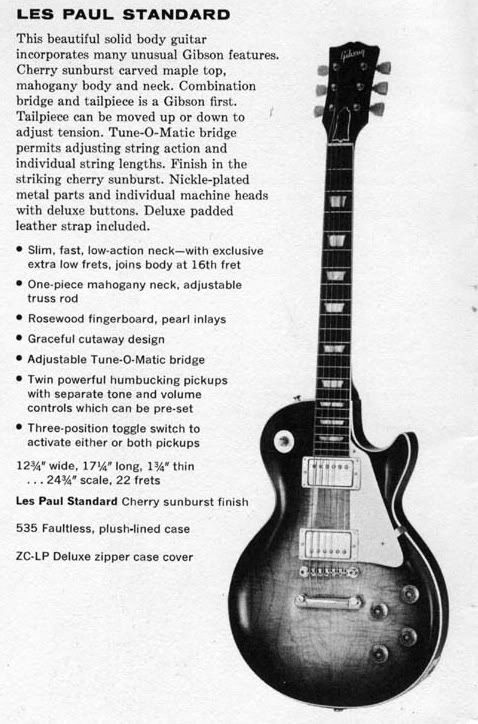
If nothing else, it's a cool ad.
NOW, with that said. Let's look at Paco's pic of his wrap over string method.

Notice he is able to take the tail piece all the way down tight to the body. This gives him more tone and better sustain, this is a fact. But because the strings are wrapped over the tail piece, he doesn't have the sharp break angle that he would if he strung the guitar in the traditional way, thereby reducing string tension and increasing twang/flexibility, etc. Notice the string stops in the tail. To keep his tail that low would be a very sharp break angle and would hit the back of the bridge, and, as the Gibson ad says, would increase tension.
The reason that is good would be up to the individual. but I like it because you can go to a heavier string and get the feel of a lighter string. I don't know about you guys, but I love the sound I get from 10's and 11's, but love the feel of 9's.
BUT, I came across a pretty cool Gibson ad when they were introducing the tune-o-matic bridge/tail set up. Notice what they say about the tune-o-matic. "the tail piece can be moved up or down to adjust tension. Tune-o-matic bridge permits adjusting string action and individual length".
If nothing else, it's a cool ad.
NOW, with that said. Let's look at Paco's pic of his wrap over string method.
Notice he is able to take the tail piece all the way down tight to the body. This gives him more tone and better sustain, this is a fact. But because the strings are wrapped over the tail piece, he doesn't have the sharp break angle that he would if he strung the guitar in the traditional way, thereby reducing string tension and increasing twang/flexibility, etc. Notice the string stops in the tail. To keep his tail that low would be a very sharp break angle and would hit the back of the bridge, and, as the Gibson ad says, would increase tension.
The reason that is good would be up to the individual. but I like it because you can go to a heavier string and get the feel of a lighter string. I don't know about you guys, but I love the sound I get from 10's and 11's, but love the feel of 9's.