
What's up all? I've just been studying...like all the time.
But once my busy period ends (which might be never), I'm planning on coming back with songs that feature live guitar. I bought a guitar and everything. Now I just need to learn how to play.
Any suggested web sites or books or anything else?
Thanks,
Lon[/list]
How To: Learn Guitar

-
stueym
- Attlee
- Posts: 466
- Joined: Wed Nov 17, 2004 2:36 pm
- Instruments: Guitar
- Recording Method: Cubase/Stenberg CI2+/Roland VG-99/RolandGR-55
- Submitting as: stueym
- Location: Lebanon, TN
- Contact:
Ditto to the above advice. Bjam practices a LOT! by learning to play then repeatedly playing songs she loves and singing her heart out. I seem to recall that was my habit too when I was her age through 19.
Also try and get patient guitarist friends to teach you a few really cool things they do and mimic it. Then varity the hell out of it to try other cool chord progressions and riffs. The ones that work on a piano/keys can be very different on a guitar depending where on the neck you play the chord variations.
So try lots of different things and don't be affraid to be derivative whilst you are learning the instrument and what is possible. Other people may hate what you are doing, but persevere and ignore the bastards unless they are guitarists telling you you are doing something technically wrong and how to fix it.
My 2 cents
Also try and get patient guitarist friends to teach you a few really cool things they do and mimic it. Then varity the hell out of it to try other cool chord progressions and riffs. The ones that work on a piano/keys can be very different on a guitar depending where on the neck you play the chord variations.
So try lots of different things and don't be affraid to be derivative whilst you are learning the instrument and what is possible. Other people may hate what you are doing, but persevere and ignore the bastards unless they are guitarists telling you you are doing something technically wrong and how to fix it.
My 2 cents
"You know, I rather like this God fellow. Very theatrical, you know. Pestilence here, a plague there. Omnipotence ... gotta get me some of that."
-
roymond

- Ibárruri
- Posts: 5263
- Joined: Sat Sep 25, 2004 3:42 pm
- Instruments: Guitars, Bass, Vocals, Logic
- Recording Method: Logic X, MacBookPro, Focusrite Scarlett 2i2
- Submitting as: roymond, Dangerous Croutons, Intentionally Left Bank, Moody Vermin, The Reverend
- Pronouns: he/him
- Location: brooklyn
- Contact:
BINGO!!!!Bjam wrote:I just started learning chords for songs I wanted to play.
As for tabs, I think the only thing tabs are good at is showing you variations for a given chord. If you have a basic progression, trying different voicings is hard until you really learn every position. But tab chord reference charts can show you a bunch of variations and you'll learn which ones work for you over time. This all becomes more natural, eventually, and you'll develop a "vocabulary" of chord voicings that define your style or "sound". This, to me, is better than learning what the original artist played, where you may sound like them but never sound like you.
Learn to read notation, practicing with beginner guitar and violin etudes. Violin etudes are great because they emphasize musical lines without emphasizing idiomatic "guitar" characteristics (open 4ths, E-minor, all the things I hate about Spanish guitar).
roymond.com | songfights | covers
"Any more chromaticism and you'll have to change your last name to Wagner!" - Frankie Big Face
"Any more chromaticism and you'll have to change your last name to Wagner!" - Frankie Big Face
-
Reist

- Roosevelt
- Posts: 3066
- Joined: Mon Jan 30, 2006 2:26 pm
- Instruments: Drums, Guitar
- Recording Method: Yamaha AW1600, Reaper
- Submitting as: Therman
- Location: Calgary
- Contact:
I totally know where you're coming from, Lonbobby. I'm basically learning guitar right now, and it's an awesome experience. Practicing is a huge thing, and so is learning songs that you enjoy ... it gives you more reason to play. The thing that I think is the most important is to try things that you don't think you can do. Playing somewhat complicated riffs slowly and building up speed really increases coordination, as I've noticed. Recording what you play is really a humbling learning experience, especially when you put it on Songfight. Good luck with learning guitar, and we're all rooting for you!
-
jack

- Roosevelt
- Posts: 3864
- Joined: Sat Sep 25, 2004 10:41 am
- Recording Method: ProTools, Logic, Garageband
- Submitting as: brody, Jack Shite, Johnny in the Corner, Bloody Hams, lots more
- Location: santa cruz, ca.
here's another thing i remember about learning. always keep your guitar sitting out, on the couch, in a chair, somewhere obvious where you will see it every day and step over it. keep it out of the case unless your traveling.
and just make it a practice to play while you're watching TV, waiting for dinner, listening to the stereo, hanging out with friends. just pick it up and riff with it. that way, you are always practicing and always have time for it. you might notice that alot of time when you are around guitarists and there's a guitar sitting around, they'll want to pick it up and play it.
and yeah, i started out by learning songs i wanted to play. i remember really wanting to learn U2's "all i want is you" so i could play it for my girlfriend at the time, then have great sex afterwards......
and just make it a practice to play while you're watching TV, waiting for dinner, listening to the stereo, hanging out with friends. just pick it up and riff with it. that way, you are always practicing and always have time for it. you might notice that alot of time when you are around guitarists and there's a guitar sitting around, they'll want to pick it up and play it.
and yeah, i started out by learning songs i wanted to play. i remember really wanting to learn U2's "all i want is you" so i could play it for my girlfriend at the time, then have great sex afterwards......
-
Bjam

- Niemöller
- Posts: 1688
- Joined: Mon Sep 27, 2004 3:24 pm
- Instruments: Singin', Guitarin', Mandolinin'
- Location: Atlanta, GA
jack wrote:here's another thing i remember about learning. always keep your guitar sitting out, on the couch, in a chair, somewhere obvious where you will see it every day and step over it. keep it out of the case unless your traveling.
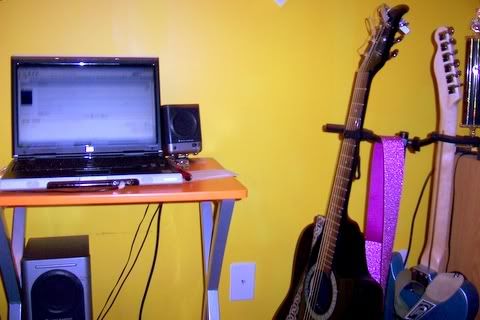
Many times that is the cause for learning a new riff instead of writing that essay for class.
Songfighter since back in the day.
-
Steve Durand
- Orwell
- Posts: 779
- Joined: Fri Apr 01, 2005 1:26 pm
- Instruments: trumpet, trombone, sax, clarinet, flute, keyboards, banjo, guitar, bass, ukulele
- Recording Method: SONAR 6, Dell Inspiron E1705, Edirol UA-25, Studio Projects B-1 Mic
- Submitting as: Steve Durand, Elastic Waste Band
- Location: Anaheim, CA
This is great advice. I just started playing guitar (and bass) in December. I probably end up playing for an hour every day just becasue I have them sitting out in my living room all of the time.jack wrote:here's another thing i remember about learning. always keep your guitar sitting out, on the couch, in a chair, somewhere obvious where you will see it every day and step over it. keep it out of the case unless your traveling.
and just make it a practice to play while you're watching TV, waiting for dinner, listening to the stereo, hanging out with friends. just pick it up and riff with it. that way, you are always practicing and always have time for it. you might notice that alot of time when you are around guitarists and there's a guitar sitting around, they'll want to pick it up and play it.
Steve
"Writing about music is like dancing about architecture" -Unknown
"Seems to me this is the point of Songfight" - Max The Cat
"Seems to me this is the point of Songfight" - Max The Cat

-
jb

- Roosevelt
- Posts: 4227
- Joined: Sat Sep 25, 2004 10:12 am
- Instruments: Guitar, Cello, Keys, Uke, Vox, Perc
- Recording Method: Logic X
- Submitting as: The John Benjamin Band
- Pronouns: he/him
- Location: WASHINGTON, DC
- Contact:
Anybody else want to tell this EXPERIENCED, TALENTED musician to practice? Geez.
I don't have web sites or books to recommend. But find a simple, beginner book and learn the following chords first:
E A D G C
They are (most of) the "open" chords, meaning you play them around the first fret on the guitar, and there are open strings in them. An open E chord is the lowest chord you can play on a guitar in "standard" tuning.
Especially valuable are E and A, because they form the basis of the primary "barre" chords. A barre chord is essentially using your first finger as a false "nut" (the thing at the top of the guitar that stops the strings) and then playing a chord with your remaining three fingers. Using barre chords you can play *any* chord just by sliding your hand up and down the neck of the guitar. If your hand is in the "E" position, you're essentially transposing the open E chord every time you move up and down. People say things like "E-position barre chord on the third fret".
So learn that E and A. Then learn e and a minor-- they're fairly simply modifications to the major chord hand positions. (For e minor you just lift one finger.)
Once you learn the two primary barre-chord positions, you can play a hundred thousand songs right off the bat.
You may find that you have trouble switching quickly between chord positions. There's no trick to it. The only way to get faster is to practice until your hand just goes there. Muscle memory.
HTH,
JB
I don't have web sites or books to recommend. But find a simple, beginner book and learn the following chords first:
E A D G C
They are (most of) the "open" chords, meaning you play them around the first fret on the guitar, and there are open strings in them. An open E chord is the lowest chord you can play on a guitar in "standard" tuning.
Especially valuable are E and A, because they form the basis of the primary "barre" chords. A barre chord is essentially using your first finger as a false "nut" (the thing at the top of the guitar that stops the strings) and then playing a chord with your remaining three fingers. Using barre chords you can play *any* chord just by sliding your hand up and down the neck of the guitar. If your hand is in the "E" position, you're essentially transposing the open E chord every time you move up and down. People say things like "E-position barre chord on the third fret".
So learn that E and A. Then learn e and a minor-- they're fairly simply modifications to the major chord hand positions. (For e minor you just lift one finger.)
Once you learn the two primary barre-chord positions, you can play a hundred thousand songs right off the bat.
You may find that you have trouble switching quickly between chord positions. There's no trick to it. The only way to get faster is to practice until your hand just goes there. Muscle memory.
HTH,
JB
blippity blop ya don’t stop heyyyyyyyyy
-
jimtyrrell
- Churchill
- Posts: 2263
- Joined: Sat Sep 25, 2004 12:43 pm
- Instruments: Guitar/bass/keys
- Recording Method: Various. Mostly Garageband these days, actually.
- Submitting as: Jim Tyrrell
- Location: New Hampshire
- Contact:
I will now try to describe a basic rhythmic guitar strum. Apologies if it doesn't make sense.
Take a 4/4 measure, to be counted 1and|2and|3and|4and|.
The strumming hand moves DownUp|DownUp|DownUp|DownUp|.
But it doesn't strike the chords on each pass. Instead, it follows the above motion pattern, hitting the strings thusly:
Down --- | Down Up | --- Up | Down --- |
This, combined with the chord forms JB describes above, is enough to get the guitar making noise like a guitar should. Again, apologies if my description is not clear.
The only other recommendation I can make is to start writing songs immediately on the instrument, using it to make whatever sounds you can. You're musically proficient enough to know what sounds good. Plus, I can't wait to hear what you come up with. Good luck!
Take a 4/4 measure, to be counted 1and|2and|3and|4and|.
The strumming hand moves DownUp|DownUp|DownUp|DownUp|.
But it doesn't strike the chords on each pass. Instead, it follows the above motion pattern, hitting the strings thusly:
Down --- | Down Up | --- Up | Down --- |
This, combined with the chord forms JB describes above, is enough to get the guitar making noise like a guitar should. Again, apologies if my description is not clear.
The only other recommendation I can make is to start writing songs immediately on the instrument, using it to make whatever sounds you can. You're musically proficient enough to know what sounds good. Plus, I can't wait to hear what you come up with. Good luck!
-
roymond
- Ibárruri
- Posts: 5263
- Joined: Sat Sep 25, 2004 3:42 pm
- Instruments: Guitars, Bass, Vocals, Logic
- Recording Method: Logic X, MacBookPro, Focusrite Scarlett 2i2
- Submitting as: roymond, Dangerous Croutons, Intentionally Left Bank, Moody Vermin, The Reverend
- Pronouns: he/him
- Location: brooklyn
- Contact:
Yeah for this. As cool as it may be to sound like some other guitar player, it's even cooler to sound like yourself. Too many people get hung up on playing "covers" and immitating so-and-so's-didly-didle-didle-didle guitar riffs. Screw that and start writing and playing in your own style. It'll take you so much farther than Ingwe.jimtyrrell wrote:The only other recommendation I can make is to start writing songs immediately on the instrument, using it to make whatever sounds you can. You're musically proficient enough to know what sounds good. Plus, I can't wait to hear what you come up with. Good luck!
roymond.com | songfights | covers
"Any more chromaticism and you'll have to change your last name to Wagner!" - Frankie Big Face
"Any more chromaticism and you'll have to change your last name to Wagner!" - Frankie Big Face
-
pegor
- de Gaulle
- Posts: 185
- Joined: Mon Oct 04, 2004 1:50 pm
- Instruments: stratocaster
- Recording Method: blaming the equipment
- Location: 39°5′50″N 120°57′14″W
As a keys player you will also enjoy what, for some reason is called chicken pickin'. So you can do melody and bass/rythm stuff all at once.
(right handedness assumed below)
learn the chords as JB described (good starting advice) and then practice not only strumming but also arpeggiate the chord with your right hand.
Placing your right thumb on the string that has the root note, index finger on the 5th, FU finger on the 8th, and ring finger on the 3rd, pinky planted on the sound box to hold your hand still. then pluck with each finger, mix up the sequence, pluck the root with the 5th ,then the root with the 3rd, etc...
Clapton and Beck and Mark Knopfler dropped their picks years ago...
(right handedness assumed below)
learn the chords as JB described (good starting advice) and then practice not only strumming but also arpeggiate the chord with your right hand.
Placing your right thumb on the string that has the root note, index finger on the 5th, FU finger on the 8th, and ring finger on the 3rd, pinky planted on the sound box to hold your hand still. then pluck with each finger, mix up the sequence, pluck the root with the 5th ,then the root with the 3rd, etc...
Clapton and Beck and Mark Knopfler dropped their picks years ago...
Last edited by pegor on Tue Jun 13, 2006 5:10 pm, edited 1 time in total.
-
Mostess

- Orwell
- Posts: 809
- Joined: Wed Sep 29, 2004 5:49 am
- Instruments: Vocal, guitar, keyboard, clarinet
- Recording Method: Ardour 5, JACK, Ubuntu
- Submitting as: Hostess Mostess
- Pronouns: He/him
- Location: Ann Arbor, MI
- Contact:
jb wrote:Anybody else want to tell this EXPERIENCED, TALENTED musician to practice? Geez.
It's so hard to not to!jb's evil twin then wrote: The only way to get faster is to practice until your hand just goes there. Muscle memory.
Another useful guitar trick is to tune the lowest string down a whole step to D and learn to play D major, A major, and G major chords. Easy way to get a fuller sound (D and G don't easily become barre chords, so JB's advice is more useful generally. But if God wanted us to learn barre chords, he wouldn't have invented the capo.)
"We don’t write songs about our own largely dull lives. We mostly rely on the time-tested gimmick of making shit up."
-John Linnell
-John Linnell
-
jb
- Roosevelt
- Posts: 4227
- Joined: Sat Sep 25, 2004 10:12 am
- Instruments: Guitar, Cello, Keys, Uke, Vox, Perc
- Recording Method: Logic X
- Submitting as: The John Benjamin Band
- Pronouns: he/him
- Location: WASHINGTON, DC
- Contact:
Q: "How do you bake a cake?"Mostess wrote:jb wrote:Anybody else want to tell this EXPERIENCED, TALENTED musician to practice? Geez.It's so hard to not to!jb's evil twin then wrote: The only way to get faster is to practice until your hand just goes there. Muscle memory.
A: "Practice."
See, there's a difference between my recommendation to practice and those previous. Sometimes when you see someone accomplishing some feat, you wonder how they do it. When you try it yourself, you can't seem to get the same results.
So you wonder, is there a trick to this? What do I need to do in order to make my body do _____? It takes someone who knows to come along and go "there's no trick to this, it just takes repetition to get faster." OR (rarely), that person will say "oh, you're making this too hard, here's the trick."
One of the roles of a teacher is to help the student identify and solve the problems they encounter in progressing towards mastery.

JB
blippity blop ya don’t stop heyyyyyyyyy
-
roymond
- Ibárruri
- Posts: 5263
- Joined: Sat Sep 25, 2004 3:42 pm
- Instruments: Guitars, Bass, Vocals, Logic
- Recording Method: Logic X, MacBookPro, Focusrite Scarlett 2i2
- Submitting as: roymond, Dangerous Croutons, Intentionally Left Bank, Moody Vermin, The Reverend
- Pronouns: he/him
- Location: brooklyn
- Contact:
Once you get things going, avoid all the barre chords entirely (or use them sparingly).
I like to use a small set of 3 or 4-note chord forms that transpose anywhere on the neck. I just put this page together quickly to illustrate some of them, grouping them by major, minor and dom7 to start. I find that using more percussive picking techniques on fewer notes can create very interesting guitar parts, sometimes alone, sometimes complimenting full out strumming. Listening to Andy Summers made me focus on smaller chord forms.
I like to use a small set of 3 or 4-note chord forms that transpose anywhere on the neck. I just put this page together quickly to illustrate some of them, grouping them by major, minor and dom7 to start. I find that using more percussive picking techniques on fewer notes can create very interesting guitar parts, sometimes alone, sometimes complimenting full out strumming. Listening to Andy Summers made me focus on smaller chord forms.
roymond.com | songfights | covers
"Any more chromaticism and you'll have to change your last name to Wagner!" - Frankie Big Face
"Any more chromaticism and you'll have to change your last name to Wagner!" - Frankie Big Face
-
Mostess
- Orwell
- Posts: 809
- Joined: Wed Sep 29, 2004 5:49 am
- Instruments: Vocal, guitar, keyboard, clarinet
- Recording Method: Ardour 5, JACK, Ubuntu
- Submitting as: Hostess Mostess
- Pronouns: He/him
- Location: Ann Arbor, MI
- Contact:
Very, very nice. (though your use of the top row of radio buttons to indicate "anywhere on the neck" does make all the chord names look a semi-tone too low).roymond wrote:this page
This thread seems to be teasing the strummers from the pickers! Definitely, smaller note sets are easier and more flexible and harmonically interesting. The full strum chords are harder to finger and switch between, but do have an immediate "hey, I'm getting good at this!" quality. This thread is fun.
"We don’t write songs about our own largely dull lives. We mostly rely on the time-tested gimmick of making shit up."
-John Linnell
-John Linnell
-
erik

- Churchill
- Posts: 2341
- Joined: Sat Sep 25, 2004 11:06 am
- Submitting as: 15-16 puzzle
- Location: Austin
- Contact:
If you know nothing about what style of music is going to be played, this is awful awful terrible soulcrushing advice. Barre chords are no worse than any other chord. How much you use them will depend on what style of music you are making, and how you want your chords to sound.roymond wrote:Once you get things going, avoid all the barre chords entirely (or use them sparingly).
-
roymond
- Ibárruri
- Posts: 5263
- Joined: Sat Sep 25, 2004 3:42 pm
- Instruments: Guitars, Bass, Vocals, Logic
- Recording Method: Logic X, MacBookPro, Focusrite Scarlett 2i2
- Submitting as: roymond, Dangerous Croutons, Intentionally Left Bank, Moody Vermin, The Reverend
- Pronouns: he/him
- Location: brooklyn
- Contact:
Well, I'm not sure I would put it in such dire tones, Erik, but barre chords all have a tonic-dominant-tonic-third heavy, soulless (and perhaps soulcrushing) weight that tends to give them all the same effect. Which, as you point out, may be stylistically JUST WHAT YOU WANT. Don't get me wrong, I use plenty of barre chords. I'm just suggesting you compliment them with more effective voicings for a broader brush to paint with and, I believe, a more distinctive one at that.erik wrote:If you know nothing about what style of music is going to be played, this is awful awful terrible soulcrushing advice. Barre chords are no worse than any other chord. How much you use them will depend on what style of music you are making, and how you want your chords to sound.roymond wrote:Once you get things going, avoid all the barre chords entirely (or use them sparingly).
roymond.com | songfights | covers
"Any more chromaticism and you'll have to change your last name to Wagner!" - Frankie Big Face
"Any more chromaticism and you'll have to change your last name to Wagner!" - Frankie Big Face